A CNAME Next to Your SPF Record: Which One Do Mailbox Providers Read? We Tested 21


Some domains publish two answers to the same question. At the name used as the Return-Path, one email service has asked for a CNAME pointing to its own domain, and someone has also published an SPF record there, for another service or out of habit. DNS doesn't allow that combination: RFC 1034 says a name with a CNAME holds no other data. Some DNS providers serve it anyway, and DMARKOFF's monitoring saw such a domain's stored SPF record flip between the two from one check to the next.
An SPF record is a TXT record, so the rule covers it: a name with a CNAME can't also hold an SPF record or an MX. The rule applies to that one name, not to the whole zone. A CNAME at bounce.example.com and an SPF record at example.com are fine together. This is a different fault from two SPF records at one name: DNS allows two TXT records, and it's the SPF spec that makes them a permerror.
So which record does a receiver evaluate when that name is the MAIL FROM domain? On 31 October 2026 we built six such names, served them from our own authoritative DNS server, which logs every query, and sent one message per name to 44 seed mailboxes at 21 mailbox providers. Every name had p=reject and no aligned DKIM signature, so DMARC rested on SPF alone. This is a follow-up to our study of broken SPF records.
Disclosure: DMARKOFF builds DMARC monitoring tools, and we read the receivers' aggregate reports for this test in DMARKOFF. The seed mailboxes came from GlockApps, which is made by the same team. All domains, IPs and accounts were our own, and the data is on GitHub.
TL;DR
- Receivers disagree on which record to read. Gmail, Google Workspace, the Yahoo family, La Poste, Zoho, Naver and mailo read the name's own SPF record. Mail.ru and Yandex followed the CNAME and read its target's. Microsoft read the target for most messages, but its mailboxes split within a single case.
- For several receivers, an MX record at the name decides. With an MX there, Interia, Onet, freenet, GMX, WEB.DE, mail.com and Libero read the name's own record. Without one, their MX lookup returned the CNAME, and SPF then read the target's record: every time at Interia, Onet and freenet, for some mailboxes at the others.
- So no layout passes everywhere. Whichever of the two records lists your sender, a share of the big receivers evaluates the other one and refuses the mail under
p=reject. - A CNAME alone is fine. The name with only a CNAME, the usual Return-Path setup for an email service, passed at every receiver.
- The reports don't point to the cause. Every aggregate report names the Return-Path domain as the SPF domain, whichever record the receiver read. The domain's owner sees the same mail pass SPF at Google and fail at Mail.ru, with nothing about a CNAME.
- The email service saw it too. During the test, Mailgun's own periodic check read the wrong record, marked two of our domains unverified and refused to send the rest of a batch.
The test
Each case was a subdomain of cx.mailpath.io, used as both the From domain and the MAIL FROM domain. "Passes" below means v=spf1 include:_spf.mailgun.org -all, which authorizes the Mailgun servers that sent the mail. "Fails" means v=spf1 -all, which authorizes nothing.
The pairs mirror each other. A receiver that accepts c03 and refuses c05 read the name's own record; one that refuses c03 and accepts c05 read the CNAME target's. c04 and c06 have no MX at the name, so a receiver that looks up the sender domain's MX before SPF gets the CNAME there instead, and its resolver may still hold it when SPF asks for the TXT record.
Amazon Route 53, which hosts the rest of our test zones, refuses a CNAME next to other records. So we delegated cx.mailpath.io to a small authoritative server on our own host and made it answer the way such zones are served in the wild: a TXT or MX query got the name's own records, any type the name lacked got the CNAME alone, and the server never followed the CNAME itself. It logged every query, so for each receiver we could see which name its resolvers asked for TXT, the name itself or the CNAME target. Every record had a TTL of 300 seconds, and the CNAME targets carried an address and Mailgun's MX, so a receiver checking that the sender domain exists got an answer through the CNAME.
We sent one message per case through Mailgun's shared IPs to 45 GlockApps addresses: 44 seed mailboxes, one per mailbox type at 21 providers and the spam-filter seeds, plus GlockApps' monitor, which accepts everything. DKIM signing for our domains was off, and each subdomain published p=reject. Mailgun still added its own mailgun.org signature to the copies bound for Gmail and the Yahoo family, as in our first study, but it doesn't align with the From domain and can't make DMARC pass. For each receiver we combined its SMTP reply in Mailgun's log, the folder the message landed in, the authentication results in the delivered message's headers, the queries in our DNS log and, where it sends them, its DMARC aggregate report.
Results
Both controls were accepted at SMTP everywhere. Of the 45 addresses per case, GlockApps' monitor included, Mailgun's log records these outcomes:
Bounced after acceptance is part of Accepted at SMTP. All eight bounced messages went to the three Microsoft 365 seeds, which accepted them and returned them with 5.7.509 afterwards.
Every one of the four conflicting cases was refused somewhere and accepted somewhere else. Per receiver:
Reads: the record the receiver's verdicts and DNS queries point to. own: the name's own SPF record. target: the CNAME target's. MX: the name's own record when the name has an MX, the target's when it doesn't. accepted: answered 250 at SMTP; the folder is given where it says something about SPF. refused: rejected during the SMTP session. bounced: accepted at SMTP, then returned with 5.7.509. not seen: accepted, no bounce, and not in the seed mailbox by 11:40 UTC on 31 October. In brackets: the SPF result in the receiver's own header. Microsoft 365 is three seed mailboxes behind Exchange Online, two of them GlockApps' Microsoft EOP and Proofpoint filter seeds. The Barracuda filter seed answered like Gmail.
¹ Onet refused c06 after the message body with a plain 554 5.7.1 Rejected, although its resolver had read the target's passing record.
Gmail and Yahoo read the name's own record
Gmail, Google Workspace and the Google filter seed accepted c03 and c04 and refused c05 and c06 with 550 5.7.26, the reply Gmail gives mail that fails DMARC. The Yahoo family did the same with 554 5.7.9. In our DNS log, their resolvers asked the name itself for TXT before anything else, and Yahoo's kept doing so even after an MX or SOA query had already returned the CNAME. La Poste, Zoho, Naver and mailo answered the same way at SMTP, and ukr.net delivered c03 and c04 to the inbox and filed c05 and c06 in spam with spf=fail.
That is what a DNS server is asked for, after all: the name's TXT record. A server that holds TXT data for the name returns it, and these receivers never look at the CNAME.
Mail.ru, Yandex and Microsoft followed the CNAME
Mail.ru did the exact opposite. It refused c03 and c04 and accepted c05 and c06. Its resolvers first asked for the domain's address, got the CNAME, and then asked the CNAME target for TXT. Yandex resolved the name the same way: it refused c04, and its headers read spf=fail for c03 and spf=pass for c05 and c06, all of them filed in spam.
Microsoft's resolvers also started with the address and got the CNAME, but Microsoft's verdicts split within a case. Of six Outlook.com and Hotmail mailboxes, four refused c03 with 550 5.7.509 and two accepted it; three refused c04, and one refused c05. The three Microsoft 365 mailboxes accepted every case at SMTP, then bounced c03 and c04 with 5.7.509, and two of the three bounced c05. Only c06 got through at all of them. Which record a Microsoft server evaluated seems to depend on what its resolver had cached at that moment, so a domain set up this way passes SPF at Microsoft some of the time.
Lab note: The record that confused the receivers confused the email service as well. Mailgun re-checks its customers' DNS on its own schedule, and while we were sending c05, its check read the name's own record, v=spf1 -all, for c05 and c06. It marked both domains unverified, and its API refused the remaining 22 of c05's 45 messages: "The domain is unverified and requires DNS configuration". We gave c05 its plain Mailgun record for 21 seconds, let Mailgun verify it, put the case records back and sent the 22 messages five minutes later.
An MX record decides for others
For a third group, the answer changed with one more record at the name. With an MX there (c03, c05), Interia, Onet, freenet, GMX, WEB.DE, mail.com, Libero and Virgilio read the name's own record. Without one (c04, c06), their MX query got the CNAME back, and SPF then read the target's record. Interia, Onet and freenet did this every time; GMX, WEB.DE, mail.com and the Italiaonline pair did it for some mailboxes and not others, so c04 was refused at three of the four United Internet seeds and c06 at two.
Apple was the least predictable. It read the target's record for c04 and the name's own for c06, though the two cases are laid out the same way, and it refused both, along with c05.
Some outcomes don't show at SMTP
- ukr.net and freenet filed the failing message in spam instead of refusing it.
- Amazon WorkMail accepted c05 and c06 at SMTP, and neither had reached the seed mailbox by 11:40 UTC on 31 October, with no bounce. It read the name's own record for all four cases.
- Proton's resolvers fetched both records, and its DMARC verdict followed the target's:
dmarc=failand spam for c03 and c04,dmarc=passand the inbox for c05 and c06. - Seznam passed all four. Its resolvers fetched whichever record passed, or both, and its aggregate report says
passeach time. - T-Online and Vodafone delivered everything to the inbox, as they did every broken record we sent them through Mailgun in our first study. Vodafone's own resolvers never asked for TXT, but four to five seconds after Vodafone accepted c02, c04, c05 and c06, two resolvers outside its network fetched the SPF record, and they appear nowhere else in the log. That timing suggests Vodafone checks SPF after accepting a message and files it in the inbox whatever the result. T-Online's resolvers never showed up.
What the receivers' own reports say
Google, Yahoo, Microsoft (Outlook.com and Microsoft 365), Mail.ru, Seznam, GMX, WEB.DE, mail.com, Interia, Zoho and Amazon sent aggregate reports for these domains. They agree with what happened to the mail: where a receiver refused or bounced a message, its report says reject with SPF fail, and where it delivered one, pass. Microsoft's reports split the way its refusals and bounces did, for example two passes and three rejects for c03 at Outlook.com. Coverage wasn't complete: Outlook.com counted five of c03's six messages, Interia has no rows for c04 and c05, which it refused at SMTP, and Amazon reported only c02, c03 and c04.
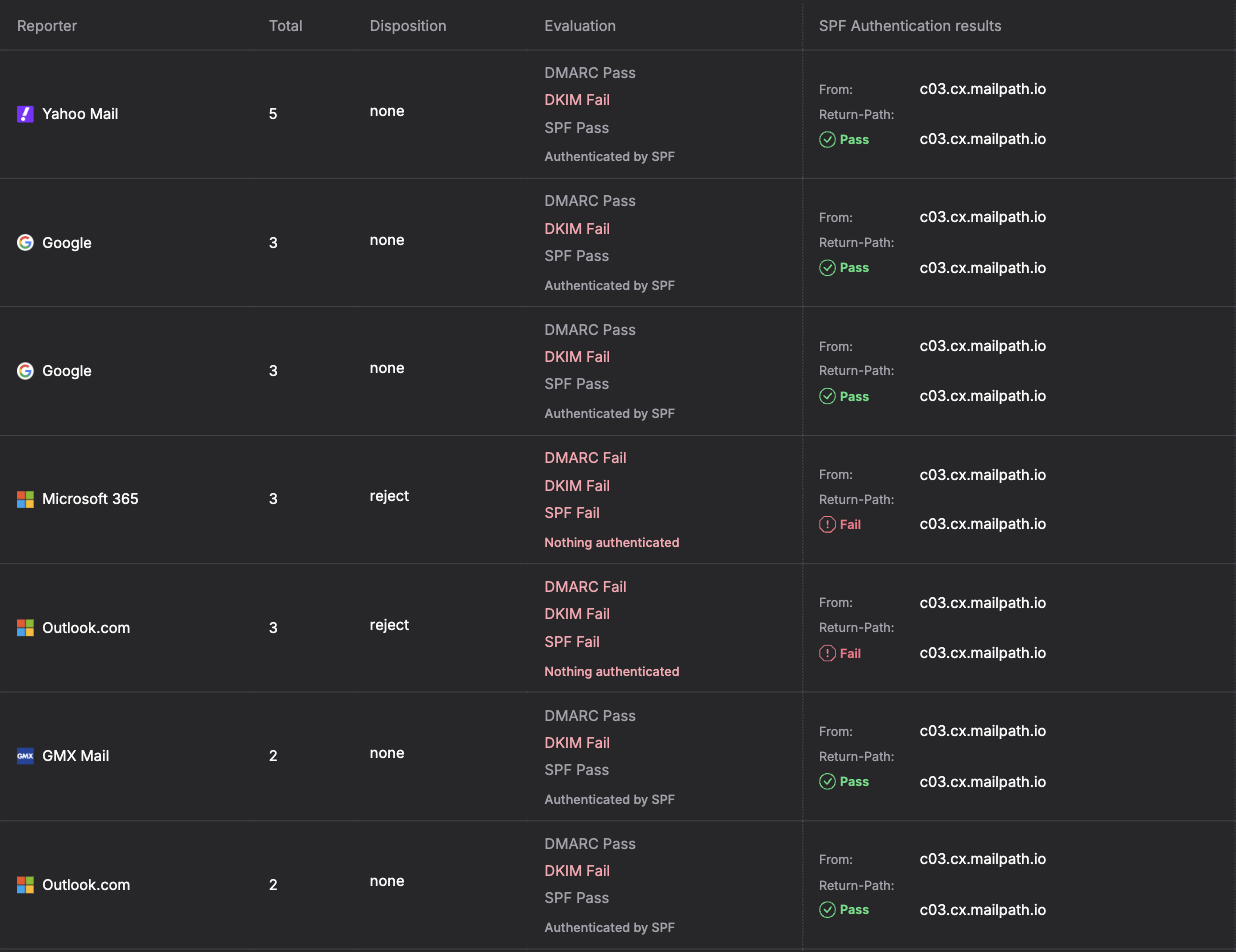
c03 in DMARKOFF by reporter, reports for 30 October to 1 November. Yahoo and Google pass SPF and DMARC, Microsoft 365 rejects, and Outlook.com reports three rejects and two passes, five of its six messages
What the reports don't show is the CNAME. Every row names the case domain as the SPF domain, whichever record the receiver evaluated. Mail.ru read the target's record and reports SPF fail for c03.cx.mailpath.io; Google read the name's own record and reports fail for c05.cx.mailpath.io. A domain owner reading these reports sees the same mail from the same sender pass SPF at some receivers and fail at others, and nothing that explains why.
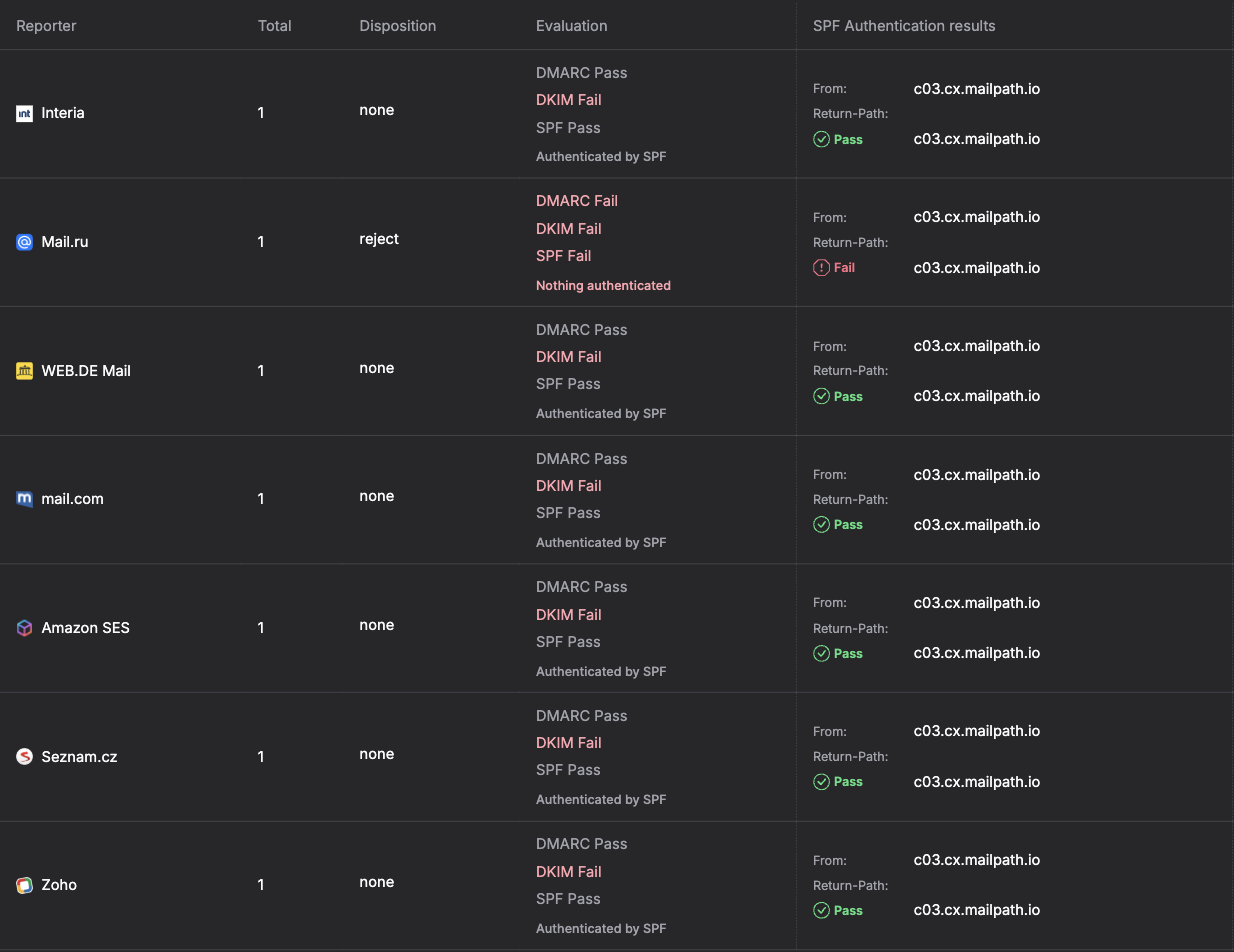
The rest of c03's reporters. Mail.ru, which read the CNAME target's record, reports SPF fail and reject for the same domain that Interia, WEB.DE, mail.com, Amazon, Seznam and Zoho pass
What it means for you: if one sender passes SPF at Google and Yahoo and fails at Mail.ru and part of Microsoft, or the other way round, look at the DNS of its Return-Path domain before you look at the sender.
What to do with your own records
- Keep a name with a CNAME free of anything else. If an email service asks for a CNAME at your Return-Path or bounce subdomain, that name can't also hold an SPF record or an MX. The CNAME target carries the service's SPF record, and the name inherits it.
- Give each service its own Return-Path name. If two services send for the same domain and one of them needs a CNAME, don't share the name. Set the other service's custom Return-Path (MAIL FROM) domain to a different subdomain in that service, and publish the records it asks for there. Then send a test message and check its
smtp.mailfrom, the SPF result and DMARC alignment: a subdomain of the From domain aligns in the default relaxed mode, whileaspf=sneeds an exact match. - Check what the zone's own name servers hold, not just what a resolver returns. A caching resolver returns whichever record it happens to hold, so a quick lookup can look clean (see below).
- Don't count on your DNS provider to refuse it. Route 53, for one, won't create a CNAME next to other records, but zones with one do get served, and the receivers then disagree as shown above.
The layout we tested, with example names. One name holds a CNAME for service A and an SPF record for service B:
The fix gives each service its own name:
To check a name, ask one of its zone's name servers for both types:
dig +norecurse +noall +answer @ns1.example.net bounce.example.com CNAME
dig +norecurse +noall +answer @ns1.example.net bounce.example.com TXT
Look at the owner name and the type of each answer. The conflict is a CNAME record and a TXT record that both belong to bounce.example.com itself. A TXT query that returns only the CNAME, or the CNAME and a TXT record owned by its target, is ordinary alias resolution: our control c02 got exactly that.
DMARKOFF's SPF checker flags this layout. It confirms the CNAME and the TXT record with the zone's own name servers, so a resolver's cache doesn't decide what it finds, and it shows the record each group of receivers sees.
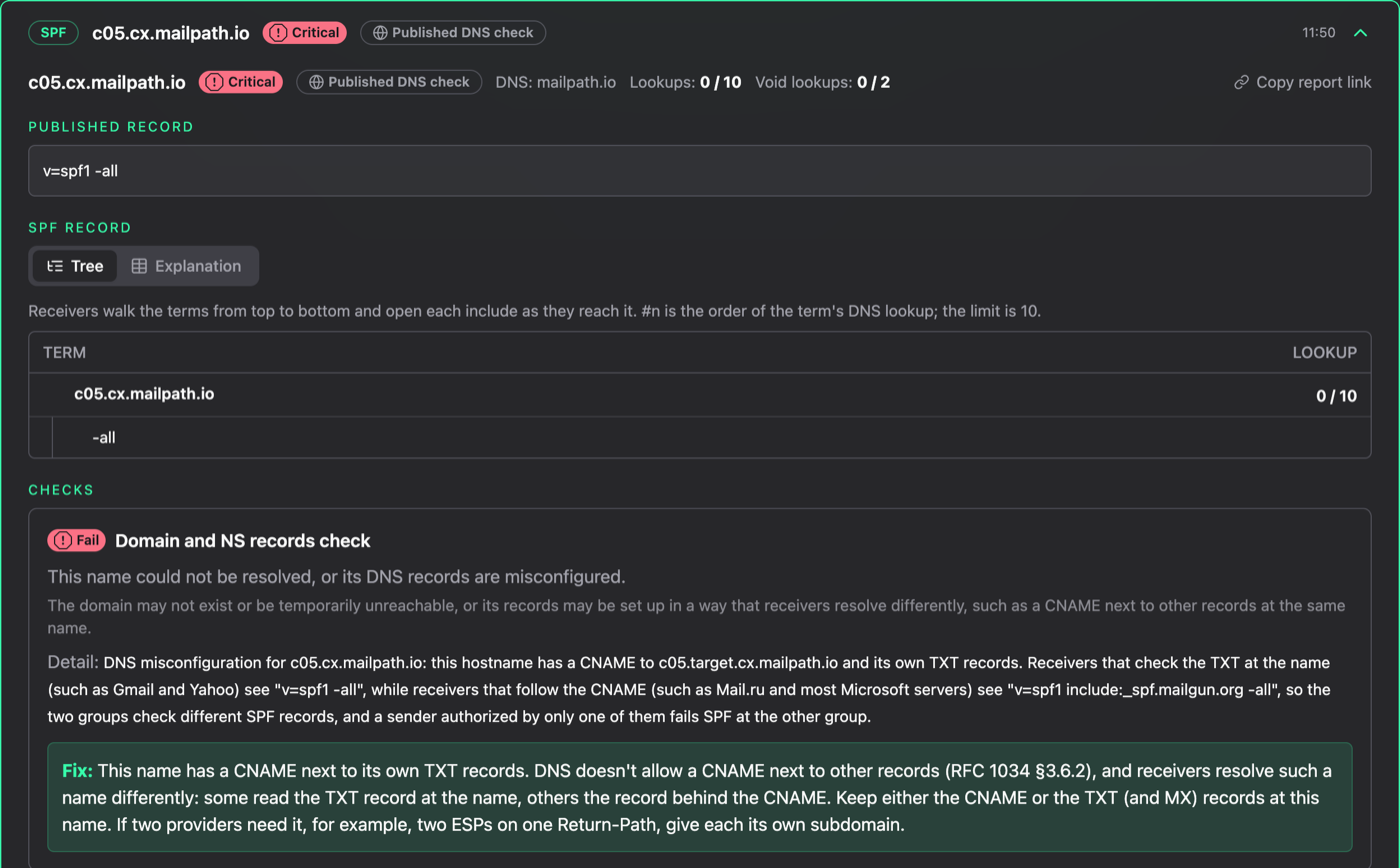
DMARKOFF's SPF checker on c05, a CNAME to the target next to the name's own TXT record, with the record Gmail and Yahoo see, the one behind the CNAME, and the fix
You can run it on your own Return-Path domain before and after you change the zone.
Limitations
- One message per case and seed. Resolver caches change from minute to minute, so the receivers that split here could fall differently in another run.
- Resolvers matched by network and timing. We tied each resolver to a receiver by its network and by when it asked. Microsoft's consumer and business mail share a network, as do GMX, WEB.DE and mail.com, and Google's resolvers also serve Google Public DNS. A receiver whose resolvers sit outside its own network can look as if it never fetched the record, as Vodafone did.
- Our own name server. It answered the way the zone that prompted the test was served. A server that resolves the CNAME itself, or refuses one type, would change what receivers see.
- SPF only. Without an aligned DKIM signature, DMARC rested on SPF. With one, DMARC can pass whichever SPF record a receiver reads; we didn't sign mail for our own domains in this run.
- Not every receiver reports. Apple, Yandex, Onet, Naver, mailo, ukr.net, Proton, Libero, Virgilio, freenet, T-Online and Vodafone sent no aggregate reports, and La Poste, which reported on our earlier tests, sent none for this one. For them we have SMTP replies, folders and headers.
Methodology and data
Date. The six cases were sent on 31 October 2026 between 10:55 and 11:18 UTC, c05 in two parts (see the lab note above). The DNS log we publish covers 10:55 to 11:40 UTC.
Sending. Mailgun's US shared IPs, with DKIM signing off. The six domains were verified in Mailgun with plain records, and the case records went live at 10:49 UTC, after the verification records' 300-second TTL had run out.
DNS. cx.mailpath.io was delegated to our own authoritative server, which logged every query. We matched resolvers to receivers by their network (AS) and by the time of each delivery.
Data. Mailgun's events (recipients reduced to their domain), the DNS query log for the case names, the per-receiver matrix, the case zone and the receivers' aggregate report extracts are in dmarcoff/articles on GitHub, run g4, archived on Zenodo with the rest of the study.
FAQ
Not by the DNS standard: RFC 1034 section 3.6.2 says a name with a CNAME holds no other data, and RFC 2181 section 10.1 repeats it. Some DNS servers serve such a zone anyway, and then resolvers and receivers disagree about which record they see.
In our test, the name's own TXT record. Gmail and Google Workspace accepted mail when that record listed the sender and refused it with 550 5.7.26 when only the CNAME target's record did. Yahoo, AOL and AT&T behaved the same way.
Mostly, but not consistently. Outlook.com, Hotmail and Microsoft 365 read the CNAME target's record for most messages, but their mailboxes split within a single case: four of six Outlook.com and Hotmail mailboxes refused one message, and two accepted it.
No. The name with only a CNAME, pointing to a target with a passing SPF record, passed at every receiver in our test. The trouble starts when the name also has its own TXT or MX record.
For some receivers, yes. With an MX at the name, Interia, Onet, freenet and the United Internet and Italiaonline mailboxes read the name's own record. Without one, they read the CNAME target's, at some of them only for part of their mailboxes.
No. The reports name the Return-Path domain as the SPF domain whichever record the receiver evaluated. What you see is the same sender passing at some receivers and failing at others.

Co-founder & CTO at DMARKOFF and GlockApps, email security specialist with 20+ years of experience, Golang & ClickHouse expert. A happy father of two teenagers.